
Review: The Bog Wife
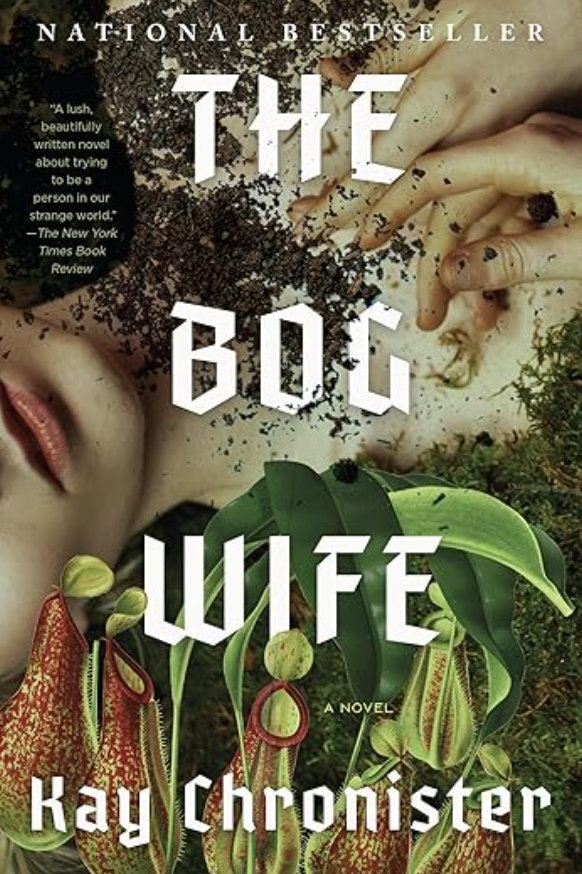
The Bog Wife by Kay Chronister is as beautiful as its cover, although I’m pretty sure those insect trappy plants don’t grow in West Virginia.
Verdict: Too pure for the average reader. For someone who enjoys beautiful novel crafting for its own sake - yes, yes, yes.
6 weeks after finishing it I’m still having some difficulty consolidating my many thoughts, mostly positive, on this book. I think I’ve found it academically satisfying in a way that maybe only a lover of book crafting can. But also personally dissatisfying as a reader. Let me explain.
First of all, it’s weird as shit and wholly unique, and I love that. I deeply appreciated the author’s imagining of what an ancient, landed legacy might look like in a geography as young (to white folks - which the main characters are) as the American Appalachian south. Even though the mythology turned out to be mostly untrue, it was still fun to play with while it lasted. But before I go further, a summary.
A group of 5 siblings raised entirely in isolation from the modern world in the hills of West Virginia (of course its West Virginia) each battle their disillusionment with the restrictive and increasingly dubious folklore from which their highly misogynistic family structure has drawn purpose for an untold number of generations. The narration shifts between each of their perspectives as their father dies and the already decaying legacy begins to unravel with fervor in a way that is both viscerally disgusting and absolutely enthralling. As the arc reaches its climax the reader is quite convinced that all this talk of bog wives (a literal woman who comes out of the bog for the purpose of procreating with the head of the household) and patriarchs is hogwash, and that the climax is going to be all the children confronting this reality together. And then it suddenly turns out to be true when their mother, one such bog wife long considered dead, suddenly emerges from the mud living and breathing after years of communing with the trees and beetles and shit.
Bog Wife is an English’s professor’s dream when it comes to portraying theoretical concepts such as imagery as content (the bog and house decaying as the legacy itself decays), pacing (perfect), structure (pristine) and suspense building. The book is as light as a feather as far as its ethereal and allegorical deftness. Beautiful prose all the way through, like a creeping vine. Graceful, dare I say elegant, even as it describes a bunch of gross stuff.
The plot twist - that the mother is, in fact, a bog wife and not an abused, vulnerable woman who was held hostage and eventually killed by their father - I would venture to guess that even the most astute reader wouldn’t see that coming. And this gets us to my conflict on whether I liked it or not. Let’s break it down.
I was impressed by the author’s courage in making the thing which she has convinced you is not true ultimately true, and that she was able to do this believably. I was appreciative of her ability to leave the reader much like the adult children themselves - torn, some going one way and some going another. Chronister makes her final point with their inevitable separation from one another, as if to say “there is no right or wrong here, and it was never going to end with any of these children leading normal lives, or even tolerable ones. A satisfying resolution was never on the table. It was always going to be irredeemably weird.” She stuck to the tenor of the story itself, and I respect the hell out of that. By these terms, I would call the novel pure, as it is unified start to finish.
But, I confess, as a reader I wanted retribution for these poor kids. I wanted the whole thing to blow up, to be proven as false, and for them to get the hell out of the bog. I wanted the catharsis of that ending, the anger and justice! The father defied, even post-mortem, and the land sold to some tiktoking fixer upper who would burn the whole thing down on top of the patriarch’s slowly sinking body. And I got none of that. Just as the children themselves did not. Which I feel confident was intentional on the author’s part.
OR I wanted the whole thing to be true and then for the novel to end by answering all my many many questions about how on earth it could be true, fully fleshing out the mythology. And I got none of that either. The mom is unearthed, but with the exception of a few initial instructions, she mostly lays around breathing until becoming one with the bog once more, not very forthcoming on any details.
Would I recommend it? To an astute reader with an eye for quality and a love for good story crafting, yes. To the average person, probably not. I think the book should be respected for what it is - its purity - and I don’t think the everyday churn and burn consumer would know what to do with that.