
Review: Priory of the Orange Tree
Verdict: Written like a trilogy. Surprise it's not! (But should have been.) Worth a read as an interesting exercise in world building. Not worth the hype.
I know, I know. I’m way late to the boat on this one. But listen, if this sucker is truly the timeless classic that everyone says it’s going to be, then I think 7 years post-release is a perfectly appropriate timeline for a review. Also I’ve been having, like, some babies and writing my own book, so not dipping much into genres that requires a lot of remembering details. Spoiler alert, turns out with Priory, there was no need for me to remember details because they weren’t important.
A few disclaimers should be mentioned. The first is that one can hardly purchase this book and avoid setting expectations about it. The ‘million copies sold’ banner sets a certain precedent. Though I’ve seen this book on the market for several years, I had never considered reading it until now, something of an obligatory urge having arisen when I reread the summary, which emphasized the centrality of women’s stories. As a writer whose shtick is about the lack of compelling women’s stories in fantasy, I thought I ought to give the best seller at least a skim. Also the author’s name is Samantha, so there was that.
Second disclaimer: I incorrectly assumed, using context clues, that this was the first novel in a trilogy. Two other books were advertised alongside it. However, those books are prequels, people! Which I discovered only after finishing Priory in a sort of shocked confusion - more on that later.
I must be even more contrary than my mother claims, because I confess I did not find the experience of reading the Priory to be anything like what was promised, and the more I’ve reflected on it after finishing the more disgruntled I’ve become with its notoriety.
Is the world building exemplary? Obviously. Is the character development engaging? Absolutely - for the main protagonists. And arguably for the many, many, m.a.n.y. other minor characters as well, which is actually half of my rub, but more on that later.
If you want to read more what’s working in the book, go read every other review of it. What did I not like about it boils down to three things:
1 - It’s paced, structured, and packed full of so many damn characters that, even if I’d known it was a stand alone novel, I still would have expected more story than what I got.
2 - The ending, which should be earned by the 800+ pages a reader has to get through to get there, left me shocked, and not in a good way. Shocked that it was suddenly over. As if the author became disinterested at the end and wrapped it up like your mom wraps up a piece of pie on a paper plate with the tinfoil she found discarded in the corner of the kitchen counter after Thanksgiving - which is to say, not well and not welcomed.
3 - Brace yourselves, this is going to be controversial. I didn’t find it to be particularly feminist. I found it to be female-centric, and there’s a big difference.
Okay - Issue 1 - Why the Hell Isn’t This a Trilogy?
Because this book is so damn long and your attention span is so damn short, I’m actually going to address these with highly specific examples. So let’s talk about how this needed to be a trilogy by talking about character development, specifically that of the two main protagonists.
First, I find the heroine Ead, on whom most of the story rests, to be distinctly disloyal and rather unreliable, which might be fine qualities in an anti-hero, but she is not positioned as such. In contrast, the other heroine, Tane, with whom the story spends less time, is a far more intriguing and endearing main character, arguably more fleshed out because of her isolation from others and the tumultuous events of her narrative arc. The story actually begins with Tane, which makes me curious if the author intended to spend more time with her but felt more comfortable with Ead, which is a real thing that us authors do. I believe Shannon hopes to rely on Ead’s many friendships and connections to help the reader make sense of her, and yet I found her far more difficult to grasp, a notion that was contributed to by her frequent disloyalties and shifting values.
And I do love an unreliable narrator, but I assure you, Shannon didn’t intend Ead to be one.
I also love a volatile or developing character whose transformation is paramount to the story. Readers crave a good evoution - and Dr. Roos gives us a sound model by which such an evolution can occur, as well as proof that the author is capable of writing a compelling character arc which includes a change in values. However, while Ead might show a softening towards the culture in which she has been planted as a spy, one which her religious order deems to be heretical, her values and fundamental beliefs do not alter - which is fine - except it leaves her as a bare-faced liar and manipulator that for some reason everyone else loves. I’m thinking specifically of her ongoing interactions with Kalyba, whom the author does not convincingly make the reader dislike (I actually felt rather compelled to root for her) enough to justify Ead’s betrayal of her. This storyline in particular - Ead v Kalyba - was disappointingly untapped.
Suffice it to say I was not engendered upon to invest much in Ead, and yet the story kept returning to her in ways I found tedious, while the far more interesting character of Tane was kept quiet for large swathes of the novel. Which I was willing to tolerate because, once again, I thought I was going to get TWO MORE BOOKS to watch them both develop. And while admit I began misinformed, the character development (as well as the sheer number of characters) reinforced my misconception over and over again because…this should have been a trilogy.
Issue 2 - Wait, It’s OVER?!?!?
This ending, folks. All is far too tidy, which causes the resolution to feel abrupt and unearned. The plot rises to a climax, the villain is sufficiently feared, several players have been put into action, and a number of things could go wrong to make this a breathtaking and delicious final battle scene - and yet nothing does.
In this, I find the author has broken that most important rule of crafting suspense - if a plan is to fail, tell the reader how it ought to go first and let them watch in horror as all goes awry. If the plan is to succeed, say nothing, and let the reader experience the plan as it unfolds. Shannon not only reveals the plan for overcoming the conflict in detail, she alters character arcs (such as that of Dr. Roos and the difficult Prioress) to make the execution of the plan even easier for the main characters.
In the end all goes exactly as it ought. The leaders of the world act with honor and immense wisdom, despite the near constant emphasis on their cultural, religious, and diplomatic differences and multi-generational estrangement from one another. A few ships are destroyed and some people we care little about are killed, but the main characters and their entourages are well taken care of, everything falls into place as hoped for, and evil is defeated as the horrid, terrifying villain literally falls onto the well-placed ancient magical blade which is the only thing that can kill him.
Ah ha! I thought to myself (still thinking I had two more books to go), the author has lulled us into a false sense of safety. In the final pages we will now discover that the victory itself has wrought an even greater evil, unforeseen by the heroes, like Brandon Sanderson’s Mistborn series. And so you can imagine my shock as I read through the montage of tidy endings for our cast of characters, all of whom survive quite nicely and ride into the sunset, as it were. The final page is read, I’m thinking “surely not”.
Cue Googling, and, alas, this is a stand alone book! Or yet a book which has been awaiting its sequel for 6 years. The more I think about it, the more disappointed I become. So many character arcs slashed in half and far too many characters (with detailed back stories!) involved for a stand alone. Perhaps the author was preparing options should she desire to pick up the story again, or perhaps she just delights in crafting side characters which appear and disappear without impacting the story enough to have been worth distracting the reader. I felt myself logging names and backstories as I read, expecting the details to be important in later books, only to find out they weren’t, in fact, important at all. It almost leads me to believe the whole novel was more of an exercise in world building, a sort of drill that went way too far.
I also found myself trying to predict the relative importance of events, lines of dialogue, story arcs - looking for Easter eggs that might key me into future plot twists. I confess there were moments when I thought the 5 High Westerns themselves were somehow connected to the many ancient women on which the world’s cultures were founded. Perhaps they have somehow been corrupted through the fruits of the Orange, Hawthorn and Mulberry trees? Erm nope. Apparently not. Just bad dragons. Bad bad dragons.
All that to say, there were a thousand places for the story to go. Instead it ended. And due to the complexity of the world building itself, the abrupt ending leaves roughly a hundred or more questions completely unresolved. So many, I don’t even have space to list them here.
Issue #3 - Female-centric
Oooookay, let’s do some term definition. Who the hell knows how to define “feminist” anyway? Not me, but even as nebulous as the phrase is, I do think there’s some distinctly non-feminist aspects of Priory, even though nearly all its main characters are female. Let’s talk about this in the terms of the Priory itself - not the book - the thing for which the book is titled.
Despite its naming, and despite setting up the Priory of the Orange Tree as a kind of secret hand working behind the thrones of all the world’s nations, the book spends only trifling amounts of time on the Priory itself. It really might more aptly be named “Ead and the Queen Tower” or “The Line of Berethnet” for all the focus it puts on the Inys plot line. The Priory is disappointingly underdeveloped and underrepresented in word count, despite being the most visionary (on the author’s part) of the many institutions created in the world.
The book is heralded as being a paragon of feminist ideals as well as being female-centric. I can agree to the later. It revolves mostly around female main characters, though there is some time spent with leading male characters as well. And most of the courts seem to operate in a non-gendered method when it comes to power and succession. There are as many women in hereditary leadership positions as men. There is, of course, the sapphic love story between Ead and Sabrin. And the few descriptions of the Priory do some work towards exploring female power structures, although for the most part it appears as though male/female roles in the Priory are simply inversed, with women serving as leaders and warriors and men serving in domestic capacities. However, with the Priory itself being disappointingly underrepresented, that is where the feminist-ness of the book ends for me.
Virginia Woolf said that a feminist is “any woman who tells the truth about her life.” A feminist book, therefore, is any book that tells the truth about the life of a woman. But Audre Lorde said “The master's tools will never dismantle the master's house.” To me, a feminist work of high caliber, especially one in a genre (high fantasy) so dominated by men, needs to not only be female-centric, but needs to envision (which Ursula K said is the role of speculative fiction) an alternative system to the ones created by men.
Shannon’s world is still inarguably male, from the way women’s bodies are systematically used and abused by institutions (Sabrin’s obligation to produce an heir), how women are discredited as alternative sources of truth by both men and other women (Kalyba’s discarded testimony), and how female manipulations are perceived as wicked or evil, while similar male manipulations are considered well-intentioned and honorable, despite their outcomes (Igrain Crest versus Seyton Combe).
Interestingly, with the exception of the Nameless One himself, who is all but silent save for a few innocuous lines at the end, and Fyredel, who is also only given a few lines to explain himself (You know, I’m just realizing this may be why the end was so weird for me. The main villains of the book are foils, not characters. More like natural disasters than villains with agency), all the other antagonists in the novel are female - Kalyba, the Prioress, Igrain Crest, Truyde, the Empress of the Tiger’s Eye Fleet. Kalyba is, in my opinion, an egregiously disserviced character, collapsed into a tropey witch despite her thousands of years of existence in order to serve the plot and deliver the murder weapon, as it were, to Ead just in time for the Nameless One to fall on it.
The Prioress and Igrain Crest both serve in their wicked matron tropes in uninteresting ways, and are both swiftly and decisively (and conveniently) removed from the story without much fuss. Truyde is interesting for a time despite being dialogically obnoxious and flat, but then she’s simply just dead. The Empress of the Tiger Eye Fleet is the only one with potential for non-tropey depth, but she, like several other minor characters, simply disappears into the ether in the rising action of the main narrative arc, never to be heard from again.
How could the book have been truly feminist? For me, works that call themselves feminist have to do 1 of 2 things; (1) openly identify systemic inequalities and/or; (2) present or envision alternatives. The Priory of the Orange Tree (the institution) seems to have sprung from the impetus to do the latter - pregnant women going into battle is always a good start when envisioning systems based on merit and choice rather than gender. But simply switching gender roles and making all the men do the chores felt like a short-cut to me, when I strongly believe that feminism is about equality and equity, not the supplanting of men in positions of power by women. Additionally, the Priory is also depicted as a highly-structured institution in which the women, although they be warriors, have few choices. At one point Ead is given the option to go on a mission she doesn’t want to go on or stay and have a baby to give the Priory more supplicants. To me that isn’t a feminist institution, that’s just a patriarchy run by women.
In short, I don’t think you can simply tell stories about women, or even from their perspectives, and call the work a feminist work - that’s female-centric. I think you have to go further to explore and envision how institutions themselves might be structurally and systematically different as a result of being built by women’s values and women’s choices - and speculative fiction is, to summarize Ursula K., one of the only safe places in which women can do so.
For all her incredible world building capabilities, which cannot be argued, Shannon fell short of something truly groundbreakingly feminist.
And it should have been a damn trilogy!
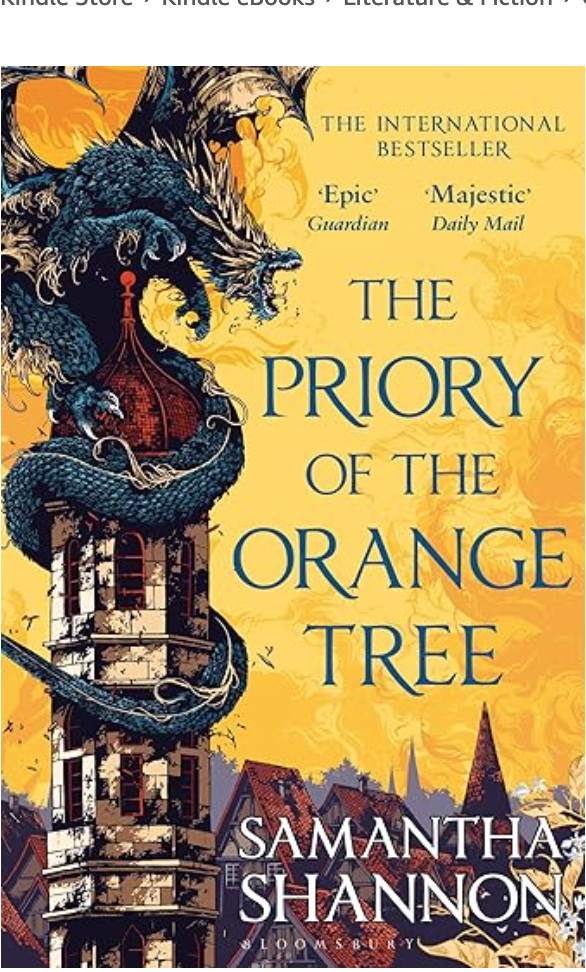
The Priory of the Orange Tree (2019), by Samantha Shannon, is heralded as one of the best high fantasy novels of the modern era.