
Review: She Who Became the Sun
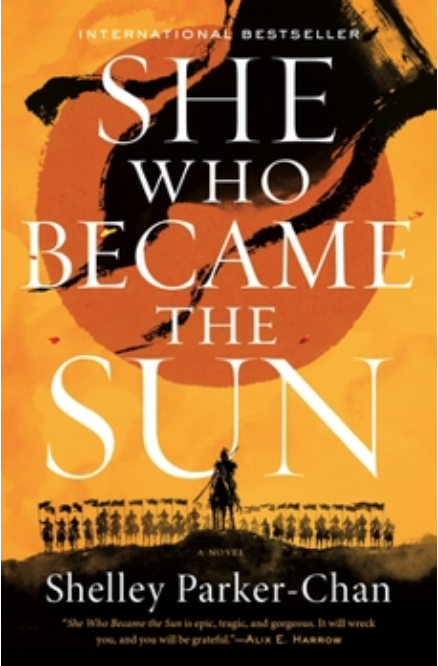
Verdict: Well-executed but uninteresting.
I’m on a Chinese literary bender. I can’t even call it exclusively literary because I also recently discovered the wide, wide world of C-dramas and, in particular, Pursuit of Jade (on Netflix) and heaven help me, I’m hooked. So She Who Became the Sun by Shelley Parker Chan is right in line with my tastes lately.
Summary
The novel centers on two MC’s. Zhu Chongba is the single survivor of her peasant family after years of famine have killed off everyone she knows. As such, she takes on her dead brother’s identity and, thus, attempts to also take on his prophesied fate of “greatness” in order to avoid her own fate of “nothingness”. She is taken in by monks and raised in a monastery, hiding her gender through more and more elaborate means as she matures.
This brings her into contact with the second MC, Ouyang, a eunuch general of the Yuan (Mongols) who have ruled over the country for the last several generations. The Yuan rule is declining, causing rebellions to arise - against which Ouyang is principally engaged. When Ouyang destroys her monastery, Zhu is cast out into the tumultuous world of the Red Turban Rebellion, determined, at any cost, to pursue her stolen fate.
Otherness, Mirroring, Agency, and Predictability
Both characters wrestle with a gendered and sexual ‘otherness’ which connects them even as they proceed to mirror each other only across battlefields. This gravitational pull in the midst of isolation is explored beautifully by Chan in a philosophical manner. Zhu is empowered by her male otherness which gives her infinite ability to rise to “greatness”, while Ouyang is constantly undercut for his lack-of-maleness, often associated with femaleness and female beauty, which severely limits his agency despite being a renowned and capable general.
Shelley comes out with a bang. The first few chapters, in which Zhu watches her brother and father die and steals the “greatness” fate, are the most well-written chapters in the whole book. From there, however, I found it increasingly difficult to continue on. I considered a DNF, but slogged through to the end hoping the quality of the characters and themes would overcome my general disinterest in the predictable plot.
The narrative is pristinely structured, although slow of pace. I would call it neatly clinical. The plot, characters, and themes are very well-written and explored. My difficulty was with the third-person narration itself, the voice and prose style, which felt more philosophical than personal, and kept me from feeling truly engaged in the story. And this is why it was difficult for me to keep picking up.
Both characters are ruthless in their pursuits of fate, struggling only slightly with the consequences of their actions. At the end of the second act Ouyang cuts off Zhu’s right hand, to which she responds with a sort of exultant appreciation, realizing that in doing so he has freed her from the need to be her dead brother. While Ouyang hurtles towards his fate, propelled by revenge, and Zhu is motivated by her fear of nothingness, both operate from an emotional distance from the violence inflicted on them and by them - even that of extreme physical and emotional suffering - which pushes the reader away emotionally. This is also true of the intimate moments between Zhu and her eventual wife, Ma, which have a detachment that borders on voyeurism, giving these scenes an eerie, pornographic feeling.
Even in the late second- and third acts, I felt no urgency to keep turning the pages. I believe Shelley is a strong enough writer that she has done this purposefully, more in a high-fantasy style, which is interesting in a duology structure, as opposed to a trilogy or longer; and with only two MCs, as opposed to a host of them. She does tell the story from a handful of additional perspectives to provide a more holistic perception of the events and to give it more emotional depth from more emotional characters, like Ma and Esen. The reader gets the sense that these characters are doomed from the start in the narrative by-product of Zhu and Ouyang’s pursuit of fate.
The progression of the narrative is as inevitable - and predictable - as those impending fates. It feels like a well strategized military engagement, in which the obvious winner wins, the obvious loser loses, and we knew it was going to end like that from the beginning.
I’m beginning to form a theory. A work in progress so give me some grace. I think if a character does not undergo personal development (or much of it) then the events surrounding the character have to hold the interest of the reader. I.e. - you need plot twists or strongly contrasting antagonists that force events to go awry. Alternatively, if you have an MC undergoing significantly development, (see Holden in The Catcher and the Rye) the author needs to hold the surrounding environment steady in order to allow the character to coherently navigate the internal flux without overwhelming the reader.
Three stars for well-executed but uninteresting. I am an author, after all. I weigh craft heavily, even if I had to make myself finish.
A final note: I was more interested in the Ouyang story line - I found him to be more engaging emotionally - and so I may pick up the second in the series, He Who Drowned the World, since it appears to revolve more tightly around him. But I’m not rushing to start book 2. I might fit it in after a few other books on my list.
Hey! Want to get smarty-pants book reviews in your inbox? Subscribe to my Substack.