
Review: The Poet Empress
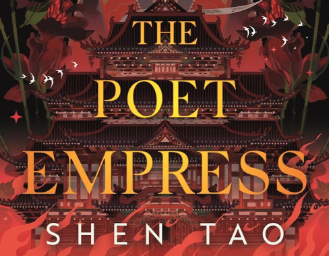
Verdict: Cinderella retelling with a wicked bent. I came to enjoy it. Started off without much dynamic uniqueness, but it really came around to refreshingly bold by the end.
Shen Tao’s The Poet Empress is a great way to talk about the role of genre expectations and how they shape the reading experience. Since this is something that I also face with my particular brand of literary fantasy, which deliberately goes AGAINST muddled genre standards, I can write about this at length. But I’ll try and just put one foot on the soap box.
Quick Summary
Wei is a poor rural villager in the sprawling nation of Tensha, where famine has taken the lives of several of her brothers and sisters, leaving her and her small brother, Bao, as the only children in their family. Tensha is ruled by a dynasty of power-gifted emperors, each with their own unique seal, which dictates the type of power they possess. The current emperor has long been ill and distant, leaving his two oldest sons to battle for the throne. When the story begins, the second son, terrifying Terren, has only just been named heir over his older brother. The chance to become a concubine in Terren’s court gives Wei an unprecedented opportunity to improve her family’s station and bring aid to her village.
So far - World building very interesting. Plot meh.
Terren, who has a reputation for being brutal and sadistic with his Dao symbol, which allows him to summon, specifically, blades and, generally, violence at will, chooses Wei as his future empress out of spite for the court. He then begins to systematically torture her while demanding she keep the abuse secret. On the outside, to all the other concubines and court members, it looks as though Wei has been elevated far beyond her station - which sparks the typical feminine jealousies and petty maneuverings of power. Wei determines not to let the corruption and manipulation of Court change her, yada yada, befriends the servants of course - Cinderella stuff. This goes on for quite some time until Wei is finally moved to cut out the tongue of one of her competitors, and this is where the story gets interesting.
Now Wei, who has secretly been learning to read - outlawed for women in Tensha - is working on a mystical poem which will eventually kill Terren. The catch is that the poem can only succeed if she is able to understand him at his core. To do so, she begins to collect testimonies from other members of court - his steward, his older brother, the current empress, etc., essentially telling the tragic story of how Terren became as he is.
There’s some very thought provoking material in this process, and Tao weaves the revelations with an expert hand. Themes of narrative ownership (he who tells the story owns the story), narrative unreliability, and just really raw child-abuse that has a certain specificity which leads me to believe the author knows what she’s talking about.
I won’t give away the third act, as this is where Tao’s story really shines, but in short, Wei finishes her poem and must decide how to use it as the ruthless and power-hungry courtiers all vie for the throne in the wake of the Emperor’s death.
Now, let’s talk about genre expectations, and let’s just be really honest about them, okay?
Assumption 1 - a woman writing fantasy is writing romantasy
This is frustrating as a female writer of fantasy. Unfortunately, the state of the genre right now is such that, if you see a woman’s name on the front of a book, you assume it’s going to have romance. Even the big literary fantasy authors - Naomi Novik, Madeline Miller, T. Kingfisher - more often than not have at least a little romance going on in their books, and more often than not the romance line is satisfyingly reconciled, meaning the characters end up together.
Now, I’m victim to this as well. And listen, I love a good romance. And the cover of The Poet Empress has a few triggers that give the reader a sense that romance will be involved, most notably the tagline “Love is a Weapon”. So I spent the first half of the book growing increasingly outraged that the author was going to somehow justify Terren’s brutality and abuse by making Wei fall in love with him in the end, having gained an understanding of his character through the completion of her mystical poem.
Which is me, the reader, operating from a genre assumption. Luckily, Tao is more trustworthy than that, and while Wei does come to sympathize with Terren through her heartbreaking discoveries of his past, she never excuses his atrocities or attempts to dismiss them.
Assumption 2 - staying “true to your heart” is a genre necessity
Did I have the 98 Degrees song “True to Your Heart” from the credits of Mulan stuck in my head the entire time I wrote this review?
Yes. Yes I did.
In 1954 Tolkien exploded the world of fantasy, which had before been a loosely defined genre of speculative fiction, starting with Mary Shelley’s Frankenstein (yes, the founder of Fantasy is a woman) with the concept that would become known as High Fantasy - or a multi-volume epic tale of good vs evil played out through the individual choices of a large cast of characters, in which golden-hearted heroes always succeed in the end, even if they take some licks along the way.
The genre-defining works that followed, The Chronicles of Narnia, The Wheel of Time, Harry Potter, most of Brandon Sanderson’s work, even the most beloved characters in Game of Thrones, all stick, some closely and some loosely, to the theme that staying true to oneself, one’s values, and one’s heritage, is ultimately the way to go, even if it gets one killed. Sorry, Ned Stark.
Add in a lot of Disney movies - listen people, these are fantasy and no matter what you think about them, they shape the genre - and tack on the big sellers by modern authors like Sarah J Maas and Leigh Bardugo, and you have the genre expectation that characters who hold to their values and convictions will be rewarded or at least honored, and those who fall to corruption will be punished.
So when Wei resolves not to let the manipulations of court change her, I very nearly put the book down. Read that story before, a thousand times.
Once again, luckily for all of us, Tao’s is more trustworthy than that. At least if you’re on the unceasing hunt for something fresh in the watered down fantasy genre these days.
Wei changes, starting with cutting out her competitor’s tongue, and it makes for a delicious and delightful second and third act of the story. Is it a moral I would teach to my daughters? Of course not. Does it make for a better book? Hell yes.
It also begins to nag at the reader - just how ruthless will she become? Ruthless enough to fight on behalf of her own abuser, and hold his throne for him? Maybe. Like honestly maybe.
In the end, Wei does return to her original motivations, but not necessarily to her original values, which is a level of complexity that satisfies deeply and makes the final chapters unpredictable and entertaining.
Smarty-Pants terms
One more note - and this is a writing capability that so often goes undiscussed by name, but every reader feels in every book they read. Narrative-character cohesion. Basically this just means that the author is able to align the emotions and perceptions of the reader to the emotions and perceptions of the MC. When this is done well, the majority of readers (you can’t please everyone) will accept the choices of the MC because their feelings are aligned with the character’s.
When it’s not done well, you know it, and the way you know it is if you’re annoyed by the MC. Their choices don’t align with what you expect them to do, or think they should do, based on how well you relate to their motivations.
Tao nails this. Wei’s mind is changing about Terren, and the reader is going right along with it. Wei’s mind is changing about power, about herself, and about her agency. While morally you might make different choices than she does, all of her choices feel appropriate and aligned with her character development and with the plot.
Narrative-character cohesion, my friends. Drop that in your next book club.